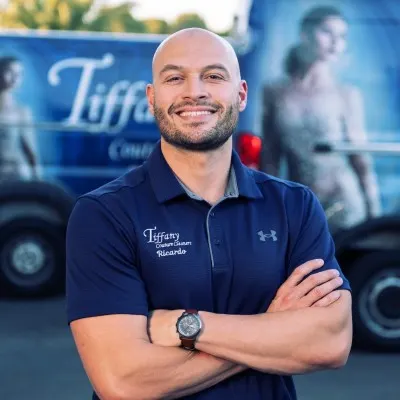
At Tiffany Couture Cleaners in Las Vegas, one driver on a strong route can produce what an entire drop store produces. If that's true in your business too, your route drivers aren't a delivery cost — they're your most productive sales channel.
That was the big idea from our latest Coffee Hour, a monthly call where dry cleaning operators compare notes. Ricardo Torres owns Tiffany Couture Cleaners, a Las Vegas luxury cleaner that's 82% pickup and delivery with a single store doing about $50,000 a month. Donovan Davis is GM of Five Star Cleaners and Dutch Boy Cleaners in San Antonio, where routes are roughly 30% of revenue. At Al Phillips in Las Vegas, we run 14 stores off one plant and routes are closer to 5% — which is exactly why I wanted to learn from them.
Below is the practical version of what we covered: how to grow a dry cleaning route, how to turn drivers into salespeople, what to do when routes stall, and real numbers on 24-hour kiosks and lockers. You can watch the full Coffee Hour on YouTube or play it right here.
Why your route driver is your best salesperson
A drop store waits for customers to come to it. A route van goes to them, several times a week, in the neighborhoods you most want to win. Every stop is a moment where neighbors see a clean, branded vehicle and a professional driver at the door. Ricardo's vans are wrapped Mercedes Sprinters, and a lot of his early growth came from exactly that: a neighbor sees the service next door and wants the same treatment.
Compare that with how most cleaners manage drivers: as a cost line, measured on stops per hour. Ricardo's point was that if one route can produce what a store produces, the driver on it deserves the same attention you'd give a store manager — context on the customer, clear expectations, and incentives. His drivers are expected to deliver white-glove service (eye contact, a smile, clear communication), and they're briefed before high-value stops. The upside for the driver is real too: good route drivers earn strong tips.
Your driver is your business on wheels. Start managing them like it.
How to turn your drivers into a sales team
For years, Tiffany Couture grew routes the organic way: be visible, hand out brochures, respond fast. Then Ricardo decided to force growth instead of waiting for it. Here's the playbook, step by step.
- Find the slack. Look at each driver's week. If a route only takes four hours on a Tuesday or a Friday, those remaining hours are your prospecting budget.
- Train before you send. Don't send drivers out blind. Coach the conversation — who to ask for, what to offer, how to follow up. Donovan's team uses outside sales training (Route Pros and a local trainer).
- Pick the right driver. Ricardo's prospecting is led by his longest-tenured, most charismatic driver, who genuinely enjoys the work. Not every driver should sell.
- Target businesses, not just homes. B2B works well from a route van: chiropractors, law offices and high-end retail stores all have staff who dress for work.
- Equip and respond fast. Drivers carry brochures and business cards that point to one inbox. Ricardo's rule: every inquiry gets a reply within five minutes.
- Measure it. Set prospecting days and track what happens — businesses visited, conversations, accounts opened. "Quantify how they do it" is what separates a program from a hope.
- Rebalance routes as they grow. When a route grows from 100 to 110 customers, move the extra stops to a neighboring route rather than overloading one driver.
The result for Tiffany Couture: growth that's now driving the purchase of another vehicle and the hire of another driver.
Brief drivers before high-value stops
Before a driver heads to a major account or a high-profile client, tell them who they're visiting and what that customer expects. A driver who knows the context shows up differently than one reading an address off a list.
Start with your top accounts
Ricardo takes his lead driver to his highest-revenue retail accounts — luxury stores like Chanel, Prada, Omega and Gucci — and meets the store managers in person. The uniforms are the account, but the real goal is the store's own customers: when someone buys a $3,000 designer piece, he wants the sales associate to recommend who should clean it.
Run scheduled routes, not will-call
Ricardo isn't a fan of will-call pickup and delivery for one simple reason: people rarely call. Consistency is what keeps a route customer, so he runs fixed schedules — the same days every week (Monday and Thursday, for example), like clockwork — plus a quick text before the driver arrives.
It works because when the van shows up, customers usually have something ready. It also keeps you top of mind: a customer who sees your driver twice a week doesn't forget you exist. With pickup and delivery software that handles scheduled stops and automatic "we're on the way" texts, that consistency doesn't depend on someone remembering to call.
Will-call waits for the customer to remember you. A scheduled route makes sure they never forget.
Get into gated communities through existing customers
Many of the neighborhoods most likely to use delivery are also the hardest to market in: gated communities and HOAs that ban door-to-door sales. Alex, another operator on the call, pointed out the workaround. One existing customer inside the gate gives your van a legitimate reason to be there, and simply driving through on schedule is advertising.
Ricardo added the psychology behind it. When residents see you serving their neighbors, they start to see you as part of the community rather than another solicitor. That's the trust barrier that door-knocking can never get past. Show up with a clean, well-wrapped vehicle and an approachable driver and the neighbors do the selling for you.
Build a referral engine where route customers already live
Ricardo's view is that pickup and delivery customers tend to be people who value their time — which often goes along with higher incomes and busy schedules. So don't market routes everywhere equally:
- Map your route customers. Heat-map where they cluster and double down on marketing in those neighborhoods.
- Ask for referrals by text. Send route customers an SMS referral offer: refer a friend who signs up for delivery and you both get a reward. Friend groups talk, and a garment bag hanging on a neighbor's door starts the conversation.
- Remove the price objection. Tiffany Couture charges the same for delivery as in-store. Compared with spending gas money on a round trip, delivery becomes an easy yes.
What to do when your routes plateau
Not every market takes to delivery the same way. Donovan was candid: in San Antonio, routes tend to plateau and customers drift back into stores, even with sales-trained drivers. His team once put lockers in more than 40 locations across the city — right where people lived and worked — and they flopped. His read is that local customers still prefer to drive and drop off.
Ricardo's advice was twofold. First, don't beat your head against the wall. If something is fading, put your energy where the business is growing. Second, before giving up on routes, check the basics:
- Are you marketing in the neighborhoods where route customers actually cluster, or everywhere?
- Are routes on fixed days, or is it effectively will-call?
- Is delivery priced the same as in-store, or is a fee creating friction?
- Are drivers briefed, trained and measured on growing their routes?
- Are you asking happy route customers for referrals?
Close mouths don't get fed: finding new accounts everywhere
Some of Ricardo's best accounts came from simply asking. When a Las Vegas production show closed and canceled its dry cleaning, his team didn't just say sorry — they asked whether any new shows were opening. That question led to new production accounts.
He also walked into the private aviation terminal near his plant (he's a pilot), asked who handled their dry cleaning, left a brochure and offered the first week free. He didn't cut his prices — he offered a risk-free trial because he was confident in the quality. The terminal is a four-minute drive from the plant, which makes it an easy account to service.
- When an account cancels, ask what's next before you let them go.
- Look at businesses near your plant or on existing routes — they're the cheapest to serve.
- Offer a free trial instead of a discount, so you're competing on quality, not price.
24-hour kiosks vs. lockers: what operators actually saw
Ricardo raised a common worry: he'd heard several stories of 24-hour kiosks plateauing after a year. So we asked the operators who have them.
Kiosks
- Al Phillips (Las Vegas): four kiosks, placed at the busiest store, the slowest store and two in between. No decline in sales at any of them; some locations needed conveyor rail extensions to keep up.
- Donovan's group (San Antonio): one kiosk store installed last year is roughly flat year over year — but it was already declining, and it's now growing month over month as customers (including route customers) adopt it. Counter staffing dropped from two or three people to usually one, and labor at that store runs in the low teens as a percentage of sales, sometimes under 10%.
- Also in San Antonio: a kiosk put into one of the slowest stores helped move it into the top five by revenue, up more than 25% over two years. Another busy store is up at least 6% year over year and gets so many Sunday drop-offs that someone goes in twice to empty the bags.
The benefits operators pointed to: coverage when someone calls out, Sunday and after-hours traffic, and a customer experience people enjoy — the kiosk greets them by name and hands over their clothes. One security tip from Donovan: keep the after-hours lobby locked and let customers in by scanning a QR code, so they know only other customers can get in.
Lockers
Lockers consistently underperformed. A bank of nearly 20 lockers at one San Antonio store barely got used compared with the kiosk that replaced it, and the 40-location locker network didn't take off. The reason is friction: any step the customer has to take in advance — calling ahead, claiming a locker, splitting a large order across several lockers — cuts usage. With a kiosk, customers just enter their number and pick up.
If you're choosing where to put your next kiosk, follow the foot traffic. A store next to a busy supermarket with packed Sundays is the obvious candidate.
Free up the owner's time to actually do this
None of this happens if the owner is stuck behind the counter. The biggest change Ricardo has seen in nearly 40 years in the industry is that the business stopped running the owner. Twenty or thirty years ago, most owners worked 12-hour days, six days a week, and never delegated. Today's operators are building systems instead.
- Delegate for real. Ricardo's rule is to empower and entrust: hand over the authority, let the other person own the outcome, and coach them. If you step back in and do it yourself, you never really delegated.
- Define ownership. At Al Phillips, with about 120 people, simply writing down who owns what took a long time — but once lanes were clear and incentives were tied to results, the team started running without me.
- Let AI handle the follow-up. Ricardo records calls (with permission) and uses a custom ChatGPT assistant to turn them into notes, email action items to the team within 15 minutes, and send reminders before the next meeting. He estimates it saves about five hours a week. AI tools built for your data can take even more of this off your plate.
- Decide what the saved time is for. Ricardo spends his on visits to top accounts with his lead driver. Freed-up hours that aren't assigned just disappear.
Route growth checklist
Frequently asked questions
How do dry cleaners grow pickup and delivery routes?
Combine visibility with deliberate sales. Wrap your vans, run routes on fixed days, answer inquiries within minutes, ask route customers for referrals, and use slack hours in drivers' days for trained, measured prospecting — especially to nearby businesses like medical offices, law firms and retail stores.
Should route drivers do sales?
The right ones should. Choose a driver who enjoys talking to people, give them real sales training first, and track prospecting activity and results. At Tiffany Couture Cleaners, driver prospecting grew routes enough to require an additional vehicle and driver.
Is scheduled pickup better than will-call for dry cleaning delivery?
In the operators' experience, yes. Will-call depends on customers remembering to call, and most don't. Fixed pickup days with a text reminder keep customers consistent, and they usually have garments ready when the driver arrives.
Do 24-hour dry cleaning kiosks increase revenue?
Results vary by location, but operators on this call haven't seen kiosks reduce sales. One slow store moved into its group's top five after adding a kiosk (up more than 25% over two years), and kiosks consistently cut counter labor and add Sunday and after-hours traffic.
Are lockers or kiosks better for after-hours dry cleaning pickup?
Kiosks. Lockers add friction (calling ahead, claiming lockers, splitting big orders), and operators reported low usage — including a 40-location locker network that didn't work. Kiosks let customers walk up, enter their number and get their clothes.
Should dry cleaners charge for pickup and delivery?
Tiffany Couture Cleaners charges the same price for delivery as in-store, which removes the main objection. Compared with the cost and time of driving to the store, free delivery becomes an easy decision for busy customers.
Want to hear it straight from the operators? Watch the full Coffee Hour conversation on YouTube — including the parts on acquisitions, rebranding and marketing agencies that didn't fit here.
Treat every driver like a store on wheels.
Run routes like clockwork and remove every bit of friction.
And ask. Close mouths don't get fed.
In this conversation

Host · Co-founder & CEO of Magnoli · owner-operator of Al Phillips Cleaners, Las Vegas